

 8 mins read
Most B2B teams do not have a lead-volume problem. They have a definition problem.
Marketing celebrates form fills, webinar registrations, content downloads, and demo requests. Sales looks at the same list and asks a different question: Which of these people are actually worth calling? When those two teams use different definitions of “qualified,” reporting becomes noisy, follow-up becomes inconsistent, and paid and organic programs get optimized toward activity instead of pipeline.
The practical fix is to separate marketing qualified leads (MQLs) from sales qualified leads (SQLs), then make the handoff measurable. This guide explains how to do that without turning lead scoring into a complicated spreadsheet nobody trusts.
MQL vs SQL: the simple definition
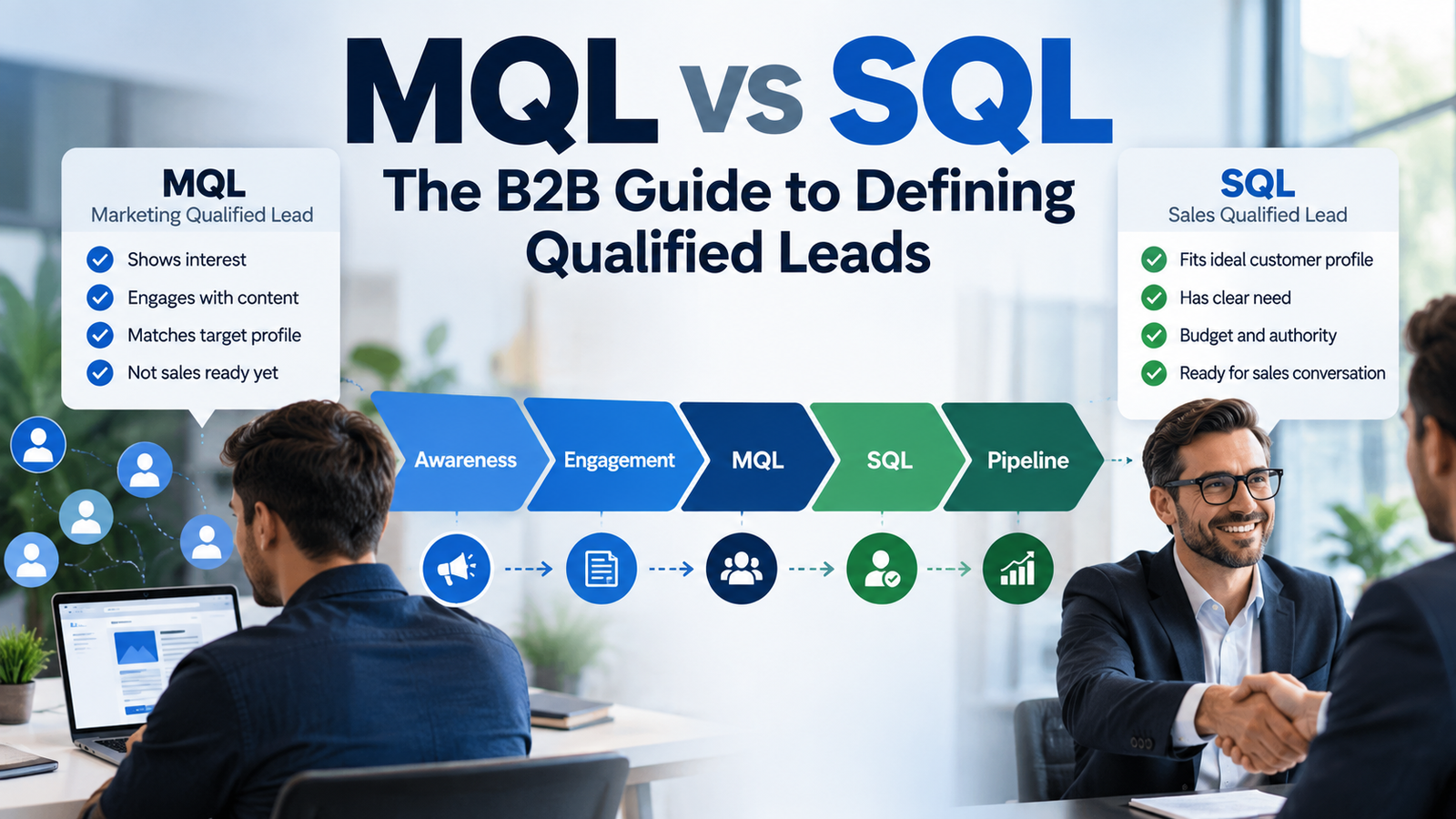
An MQL is a lead that marketing believes is worth sales review because the person or account fits the target profile and has shown meaningful interest. An SQL is a lead that sales has reviewed and confirmed is worth active pursuit.
That distinction matters. An MQL is a signal. An SQL is a sales-accepted judgment.
HubSpot’s updated MQL vs SQL guidance similarly separates marketing engagement from readiness for direct sales engagement. Salesforce describes MQLs as prospects showing interest while SQLs are further along and ready for a sales conversation.
| Dimension | MQL | SQL |
|---|---|---|
| Primary owner | Marketing | Sales |
| Evidence | ICP fit + meaningful behavior | Human-validated fit, need and buying context |
| Typical action | Route for review or nurture | Active sales follow-up |
| What it should not mean | Anyone who filled a form | Anyone sales happened to call |
Why MQL and SQL definitions matter more than lead volume
Imagine a campaign generates 100 leads. If marketing calls all 100 “qualified,” the headline number looks impressive. But if sales finds only 12 relevant companies and just five have a real project, the campaign did not generate 100 meaningful opportunities.
This is why B2B performance should be judged deeper in the funnel. At RSXigital, our view is straightforward: marketing should help create qualified pipeline, not merely make the top of the funnel look busy.
Clear lifecycle definitions improve three things immediately. First, sales knows which leads deserve fast attention. Second, marketing gets useful feedback about which channels, keywords and content attract real buyers. Third, leadership can compare campaigns using business outcomes instead of raw lead counts.
What should qualify someone as an MQL?
A good MQL definition combines fit and intent. Using only one produces bad handoffs.
1. Start with ICP fit
Ask whether the company resembles the type of customer you can genuinely help. Useful fields may include industry, geography, employee count, revenue band, business model, technology environment, or another criterion specific to your offer.
Then assess the person. A student downloading a guide and a VP evaluating vendors should not receive the same score simply because both completed the same form.
2. Add meaningful behavior
Not every website action carries equal intent. A blog visit is useful engagement, but it is weaker than repeated visits to a service page, a pricing inquiry, a case-study view followed by a contact request, or a demo submission.
For organic acquisition, this is particularly important. A traffic target such as 10,000 monthly organic visits only creates business value when the content portfolio also attracts people searching around problems your company solves. That is why a B2B SEO strategy should connect informational traffic to commercial pages and measurable conversion paths.
3. Add negative qualification
Lead scoring should be able to subtract as well as add. Wrong geography, student/research intent, consumer inquiries, job seekers, vendors, competitors, tiny accounts below a practical threshold, and obviously invalid data may need to reduce or eliminate a score.
The point is not to make your form difficult. The point is to stop treating every conversion as equally valuable.
What turns an MQL into an SQL?
An SQL needs human validation. Sales should confirm enough buying context to justify continued pursuit. That does not mean every SQL must already have a signed-off budget and purchase date. Complex B2B buying rarely behaves that neatly.
A useful qualification conversation should establish four things:
- Problem: Is there a real business problem or growth objective?
- Fit: Can your company realistically solve it?
- Buying path: Is the contact a decision-maker, influencer, champion, or able to connect the right people?
- Timing: Is there a plausible project window or next step?
Frameworks such as BANT can help structure this discussion, but they should not become a rigid interrogation. Salesforce notes budget, authority, need and timing as useful distinctions in qualification. The underlying principle matters more than the acronym: sales should validate what marketing could only infer.
Should you add a Sales Accepted Lead stage?
For teams with meaningful lead volume, often yes.
A Sales Accepted Lead, or SAL, sits between MQL and SQL. Marketing routes the MQL. Sales then accepts, rejects or recycles it after an initial review. Only after further qualification does it become an SQL.
A practical B2B handoff flow
Visitor → Lead → MQL → SAL → SQL → Opportunity → Customer
Marketing identifies fit and intent → sales accepts the lead → sales validates the buying situation → a genuine deal enters pipeline.
This extra stage is useful because it separates two questions: “Should sales look at this?” and “Has sales confirmed this is a genuine prospect?” Without that distinction, rejected MQLs and poorly qualified SQLs often get mixed together.
A practical MQL scoring model
Do not copy someone else’s point values. Build your model from your own closed-won and closed-lost data. Start simple enough that marketing and sales can explain it in a minute.
For example, a B2B services company might score account fit first, then layer behavioral intent. A target-industry director at a suitable company who visits a service page and requests a consultation should rise quickly. A low-fit contact who downloads three top-of-funnel guides should not.
A useful structure is:
- Fit score: company, geography, seniority, role and commercial fit.
- Intent score: service-page activity, case-study engagement, return visits, demo/contact actions and other high-intent behavior.
- Negative score: disqualifying profile or behavior.
- MQL threshold: the point at which the lead deserves sales review.
Then recalibrate the threshold from downstream results. If sales rejects most MQLs for the same reason, the model is telling you something. Fix the definition rather than simply asking sales to make more calls.
How paid media should use MQL and SQL data
This is where the distinction starts affecting budget.
If Google, LinkedIn or Meta only receives a “lead” conversion, the platform is rewarded for finding more people likely to submit the form. That is not necessarily the same population likely to become qualified pipeline.
Where your CRM and advertising setup allow it, pass deeper lifecycle outcomes back to the platforms. At minimum, compare campaigns by MQL and SQL creation rather than CPL alone. For higher-spend programs, offline conversion imports and CRM feedback can help bidding systems learn from outcomes closer to revenue.
This is central to how we approach Google Ads for B2B and LinkedIn Ads for B2B: cheap leads are not automatically good leads.
How organic search fits the same pipeline model
SEO has the same measurement problem in a different costume. Traffic can grow while pipeline remains flat if the site attracts broad informational demand without building routes toward commercial intent.
For a B2B site targeting significant organic growth, content should cover the buyer’s questions across the journey while deliberately supporting service pages, comparison pages, proof, case studies and conversion opportunities.
That also matters as discovery expands beyond traditional search. Buyers increasingly encounter brands through AI-assisted research as well as Google. Your content therefore needs clear entities, specific expertise, useful comparisons, evidence and consistent business information. Our AI search visibility work follows the same principle: visibility is useful only when it helps the right buyers understand and trust the business.
Five metrics to put on the same dashboard
Instead of debating whether marketing or sales “owns” pipeline, put the shared funnel on one dashboard:
- Lead → MQL rate: Are acquisition programs attracting suitable prospects?
- MQL → sales acceptance rate: Does sales agree with marketing’s definition?
- MQL/SAL → SQL rate: Are accepted leads becoming genuine sales conversations?
- SQL → opportunity rate: Is qualification producing forecastable pipeline?
- Pipeline and revenue by original source: Which channels and campaigns create commercial value?
Do not obsess over a universal “good” conversion percentage. Conversion rates vary dramatically by ACV, market, channel, offer and how strict each lifecycle stage is. Your own historical funnel is the more useful baseline. The important thing is that everyone uses the same definitions.
The MQL-to-SQL operating checklist
- Write one shared MQL definition based on ICP fit plus intent.
- Write one SQL definition that requires sales validation.
- Add SAL if you need a clear accept/reject checkpoint.
- Document rejection and recycle reasons in the CRM.
- Agree on follow-up ownership and response expectations.
- Report paid and organic channels against deeper funnel stages.
- Review the definitions monthly or quarterly using actual pipeline data.
- Feed qualified outcomes back into acquisition platforms where practical.
Final takeaway: optimize for the handoff, not the label
MQL and SQL are useful only when they change what your teams do next.
An MQL should tell sales, “This account fits and has shown enough intent to deserve attention.” An SQL should tell the business, “Sales has validated this prospect and there is a credible reason to keep pursuing it.”
If those definitions are clear, marketing can optimize toward quality, sales can focus its time, and leadership gets a much more honest view of pipeline. If the definitions are vague, adding more leads usually adds more noise.
That is also the standard we use when evaluating B2B growth programs at RSXigital. The objective is not to manufacture impressive activity reports. It is to build a measurable path from visibility and demand to qualified pipeline. You can learn more about the thinking behind that approach on Manjeet Yadav’s profile or start with our recent guide to B2B lead generation strategies.