

 8 mins read
A B2B marketing strategy should explain how your company will create demand, capture existing demand, convert the right buyers, and measure what reaches pipeline. It should not be a list of channels with a budget beside each one.
That distinction matters because B2B growth usually breaks somewhere between acquisition and sales. A campaign may generate clicks but weak leads. SEO may grow traffic without creating buying conversations. LinkedIn may reach the right job titles but send them to a page that gives them no reason to act. The strategy has to connect all of those pieces.
This guide lays out a practical framework for building a B2B marketing strategy for a US market, especially when the goal is qualified pipeline rather than activity for activity’s sake.
B2B marketing strategy, in one sentence:
Choose the buyers you want, understand the problems that trigger action, create and capture demand across the right channels, convert that interest with proof and qualification, then use CRM and sales feedback to scale what creates real pipeline.
What is a B2B marketing strategy?
A B2B marketing strategy is the plan for reaching business buyers, helping them understand a problem and solution, converting suitable prospects, and connecting marketing activity to sales outcomes.
It should answer five questions: who are we trying to reach, what problem matters enough for them to act, where can we reach them, what evidence will help them trust us, and how will we know the activity created commercial value?
At RSXigital, that last question is central. Our B2B lead generation approach is built around qualified pipeline, not simply form fills.
1. Start with the ideal customer profile, not the media plan
Before choosing Google Ads, LinkedIn, SEO, Meta, outbound, or anything else, define the accounts you actually want sales to speak with. A useful ICP includes industry, company size, geography, business model, deal size, sales cycle, and the conditions that make a company a good or bad fit.
Then identify the people involved. B2B purchases often include more than one stakeholder. The person searching for a solution may not be the person approving budget. Content and campaigns should account for both.
Write down the buying trigger as well. A trigger might be poor lead quality, rising acquisition cost, a new market launch, an upcoming compliance requirement, a sales target, or a technology change. Triggers make messaging more specific because they explain why a buyer would act now.
2. Separate demand creation from demand capture
Some buyers already know what they need. Others only know they have a problem. A healthy strategy usually needs both demand capture and demand creation.
| Role | Typical channels | Best for | Primary metric |
|---|---|---|---|
| Capture demand | Google Search, commercial SEO pages | Buyers already looking for a solution | Qualified enquiries, SQLs |
| Create demand | LinkedIn, Meta, expert content | Reaching suitable buyers before active search | Engaged target accounts, assisted pipeline |
| Convert demand | Landing pages, proof, forms, CRM handoff | Turning interest into useful sales context | MQL-to-SQL rate |
Google Ads can be especially useful when search intent is clear. LinkedIn can be useful when the target company and role are easier to identify than the query. SEO supports both because it can capture active demand and educate buyers across the research journey.
3. Give every channel a specific job
Channel strategy gets messy when every platform is expected to do everything. Decide what each channel is supposed to achieve.
- Google Ads: capture high-intent searches and validate commercial messaging.
- LinkedIn Ads: reach specific companies, industries, job functions, and seniority levels.
- Meta Ads: create or reinforce demand where creative, first-party data, and retargeting can work. See our B2B Meta Ads approach.
- B2B SEO: build durable visibility across problems, comparisons, services, and use cases. See our B2B SEO service.
- Content: answer the questions buyers ask before they are ready to speak with sales.
- Landing pages: make the offer, fit, evidence, and next step clear.
A channel should earn more budget because it creates better commercial outcomes, not because it is fashionable or because its platform dashboard looks busy.
4. Build the message around the buyer’s problem
B2B messaging becomes weak when it starts with the company instead of the buyer. “We are a full-service agency” tells a prospect almost nothing. “Improve lead quality by connecting acquisition, qualification, and CRM feedback” gives the buyer something concrete to evaluate.
A useful message structure is: problem, consequence, desired outcome, approach, evidence, and next step.
Different stages need different levels of detail. A top-of-funnel guide may explain the problem. A comparison page should help a buyer choose between approaches. A service page needs to explain fit, process, proof, and what happens after contact.
5. Build conversion paths before increasing traffic
Traffic is expensive when the site does not know what to do with it. Before scaling acquisition, review whether high-intent visitors can quickly answer:
- Is this service for a company like mine?
- Do these people understand my problem?
- What exactly will they do?
- What evidence supports the claims?
- What should I do next?
That is why B2B landing page optimization belongs inside the growth strategy, not as a cosmetic project after campaigns are already spending money.
6. Define qualification before launch
Agree on what makes a lead useful before traffic starts arriving. Otherwise marketing may optimize for one outcome while sales evaluates another.
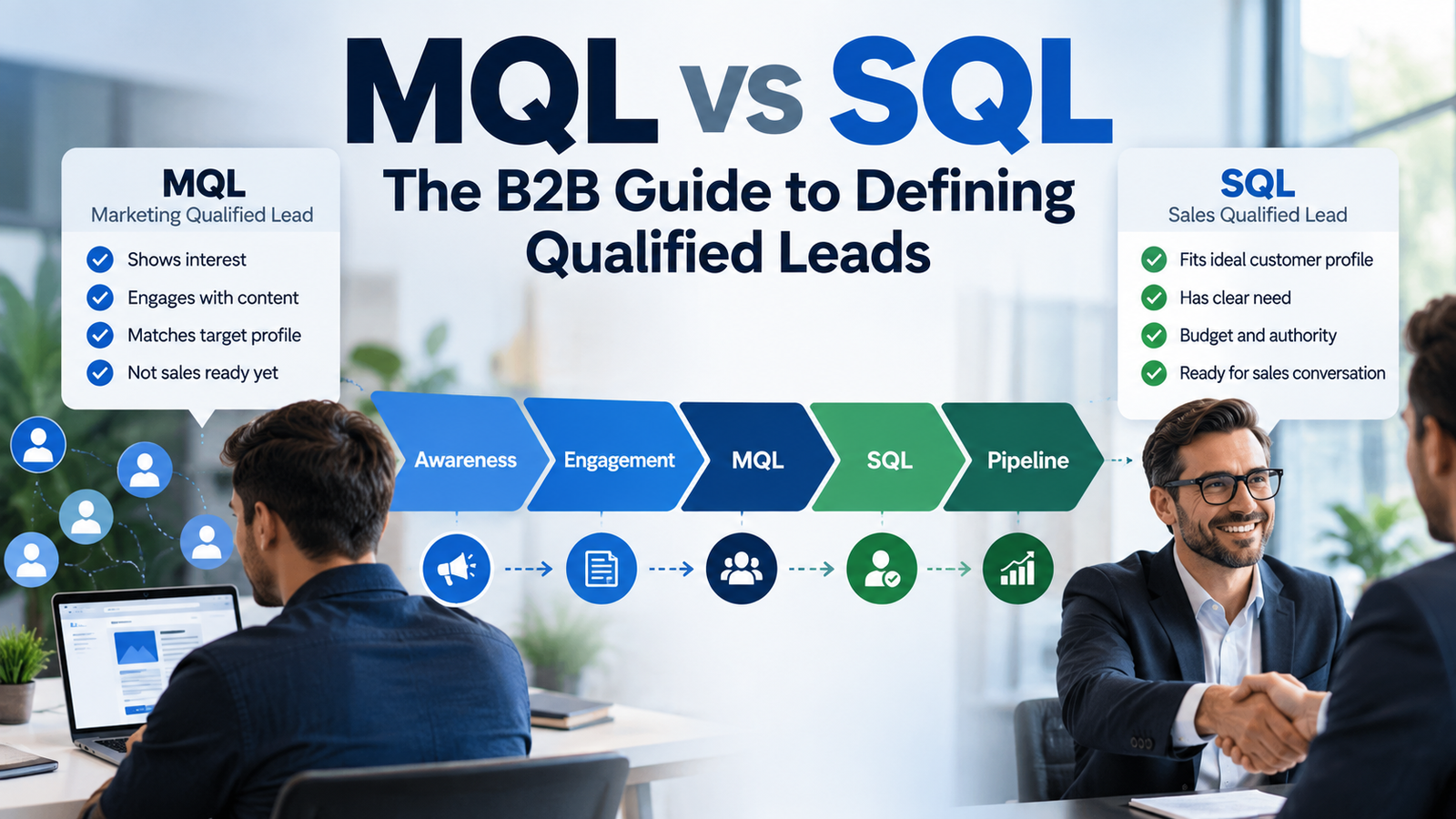
A practical qualification model can combine company fit, role, geography, need, budget range, timeline, and evidence of intent. You do not need to ask every question on a form. You do need a shared definition of an MQL and an SQL.
Our guide to MQL vs SQL explains how that handoff can be defined without turning the CRM into bureaucracy.
7. Connect marketing to downstream outcomes
Measure traffic and CPL, but do not stop there. A better B2B reporting sequence is lead → MQL → SQL → opportunity → pipeline → revenue. That sequence exposes an uncomfortable but useful truth: the campaign producing the cheapest leads may not be the campaign producing the best opportunities.
For paid search, Google now recommends enhanced conversions for leads and Google Ads Data Manager as a way to connect first-party lead outcomes with ad measurement. For a B2B team, that means a qualified sales event can become part of campaign learning instead of leaving the ad platform to optimize only for form submissions.
Leadership reporting should separate what a channel directly sourced from what it influenced. The goal is not to manufacture perfect attribution. It is to make better budget decisions using the strongest evidence available.
8. Build for Google and AI search as one discovery system
Buyers now research through traditional search, AI-assisted search, vendor sites, social posts, communities, and peer recommendations. That does not justify creating a separate content universe for every interface. It makes clarity and evidence more important.
Google’s current guidance for generative AI features in Search explicitly recommends valuable, non-commodity content with a distinctive point of view rather than pages that merely summarize what already exists. Its broader people-first content guidance also emphasizes original information, substantial coverage, accuracy, expertise, and a satisfying page experience.
For a B2B company, the practical work is straightforward:
- State the entity clearly: company name, service, market, audience, and expertise should be easy to connect.
- Answer first, explain second: important sections should begin with a direct answer before adding nuance.
- Show the operating logic: frameworks, comparison tables, checklists, and decision criteria are easier to understand than vague thought leadership.
- Connect expertise to people: link important strategic content to credible expert or founder profiles where relevant.
- Support claims: use first-party evidence, case studies, official documentation, or clearly identified examples rather than decorative statistics.
- Build topic relationships: connect strategy articles to service pages, case studies, related guides, and conversion pages with descriptive internal links.
RSXigital’s AI search visibility service focuses on that overlap between SEO, entity clarity, expertise, and discoverability. The objective is not to “game an LLM.” It is to make the business easier for search and AI systems to understand, retrieve, and represent accurately.
A one-page B2B marketing strategy template
A useful strategy should be simple enough that marketing, sales, and leadership can all explain it. Before building a 40-slide plan, write one page covering these seven decisions:
- ICP: Which companies and roles are worth pursuing, and which should be excluded?
- Buying trigger: What changes or problems make those buyers actively look for help?
- Core message: What problem do you solve, what outcome matters, and why should the buyer believe you?
- Demand plan: Which channels will create demand, and which will capture existing demand?
- Conversion path: Which pages, proof assets, forms, and offers move the buyer forward?
- Qualification: What makes a lead an MQL, an SQL, and a real opportunity?
- Measurement: Which channel and content decisions will be judged against pipeline rather than surface-level activity?
If the team cannot answer those seven questions clearly, adding another channel usually creates more noise. A strategy becomes useful when it helps people decide what to do, what not to do, and what evidence justifies the next dollar of investment.
A 90-day B2B marketing strategy framework
Days 1-30: Diagnose. Define ICP, buying triggers, existing channel performance, sales objections, conversion gaps, tracking issues, and commercial priorities.
Days 31-60: Build. Improve high-intent pages, launch or restructure priority campaigns, publish content around key buyer questions, and connect tracking to CRM stages.
Days 61-90: Learn and scale. Compare channels by lead quality, identify where good opportunities are coming from, improve weak handoffs, and increase investment only where downstream evidence supports it.
Common B2B marketing strategy mistakes
- Choosing channels before defining the buyer.
- Optimizing for cheap leads instead of useful opportunities.
- Publishing content without a commercial architecture.
- Sending every campaign to the same generic page.
- Keeping paid media, SEO, CRM, and sales reporting in separate silos.
- Scaling budgets before the qualification model is stable.
Frequently asked questions about B2B marketing strategy
What is a B2B marketing strategy?
A B2B marketing strategy is the plan for reaching suitable business buyers, creating or capturing demand, converting interest into qualified opportunities, and connecting marketing activity to sales outcomes. It should define the audience, message, channel roles, conversion path, qualification model, and measurement system.
What is the best B2B marketing strategy?
There is no universal best channel mix. The strongest strategy depends on the buyer, market, deal size, sales cycle, buying trigger, and how easily demand can be identified. Most mature programs combine demand capture, demand creation, conversion optimization, and sales feedback rather than relying on one acquisition channel.
Which channels work best for B2B?
Google Ads is useful when buyers actively search. LinkedIn can reach defined professional audiences. SEO can build durable visibility across commercial and research intent. Meta can support demand creation and retargeting. Email, communities, referrals, partnerships, and outbound can also contribute. The right mix depends on where the ICP can be reached and what evidence is available about lead quality.
How should B2B marketing success be measured?
Track visibility, traffic, engagement, and lead volume as diagnostic metrics, then connect them to MQLs, SQLs, opportunities, pipeline, and revenue. The deeper the sales cycle, the less useful it is to judge marketing only by clicks or CPL.
How does SEO fit into a B2B marketing strategy?
SEO can capture existing demand, support buyers researching a problem, strengthen service-page visibility, and create a connected body of expert content around the company’s commercial themes. A strong B2B SEO strategy should link informational discovery to proof, services, and conversion paths rather than chasing traffic in isolation.
How can B2B content become more visible in AI search?
Use direct answers, distinctive expert analysis, clear entity relationships, descriptive headings, strong internal links, evidence-backed claims, and content that fully resolves the buyer’s question. AI visibility is more durable when the same page is useful to a human buyer and understandable to retrieval and search systems.
Final takeaway
A useful B2B marketing strategy makes the route from buyer problem to revenue visible. Define the ICP, give each channel a job, build strong conversion paths, agree on qualification, and measure what reaches pipeline.
A simple B2B strategy scorecard
Before increasing budget, review the strategy against a short scorecard: Is the ICP specific enough to exclude poor-fit accounts? Does each channel have a defined job? Do campaign messages match the landing page? Can sales explain why leads are accepted or rejected? Can reporting connect activity to MQLs, SQLs, opportunities, and revenue?
If two or three of those answers are unclear, adding more traffic usually magnifies the weakness rather than fixing it. Strategy is not the document created before execution. It is the operating logic used to decide what gets more investment, what needs repair, and what should stop.
The strategy becomes more effective when paid media, SEO, content, landing pages, CRM data, and sales feedback operate as one system. That is also the thinking behind RSXigital’s broader approach to B2B growth.