

 8 mins read
B2B digital marketing is the use of digital channels to help business buyers discover, evaluate, and engage with a company. The useful version of it is not “be everywhere.” It is choosing the channels that match buyer intent, building pages that convert the right people, and measuring what becomes pipeline.
That matters because B2B buyers rarely move in a straight line. One person may discover your company through LinkedIn, another may search your service on Google, and a decision-maker may only enter the journey after reading a case study or comparing vendors.
A strong digital marketing system therefore needs more than traffic. It needs clear positioning, connected channels, proof, qualification, and reporting that survives beyond the form submission.
B2B digital marketing, in one sentence:
Use the right mix of search, paid media, content, email, conversion pages, and CRM feedback to reach suitable business buyers, move them toward a decision, and measure what becomes qualified pipeline.
What is B2B digital marketing?
B2B digital marketing covers online activities used to attract and convert buyers on behalf of another business. Common channels include paid search, paid social, organic search, email, content, webinars, retargeting, and conversion-focused website experiences.
The difference from many consumer programs is not that B2B buyers are somehow less human. It is that purchases often involve higher stakes, more stakeholders, longer evaluation, and more internal approval.
The main B2B digital marketing channels
| Channel | Best role | Typical strength | Main risk |
|---|---|---|---|
| Google Ads | Demand capture | High-intent searchers | Broad intent and expensive irrelevant clicks |
| LinkedIn Ads | Targeted demand creation | Company and professional targeting | Weak offers can make clicks expensive |
| Meta Ads | Demand creation and retargeting | Creative reach and first-party audiences | Loose targeting can reduce lead quality |
| B2B SEO | Organic discovery | Compounding visibility across the journey | Traffic can grow without commercial relevance |
| Nurture and follow-up | Direct communication with known contacts | Generic sequences quickly become noise |
1. Google Ads for active B2B demand
Google Ads is useful when a buyer can describe what they need in a search box. That includes searches for a service, platform, consultant, vendor, product category, implementation partner, or pricing information.
For B2B campaigns, lead quality often depends on search intent more than volume. A broad keyword can look attractive in a forecasting tool but still pull in students, job seekers, consumers, competitors, or buyers outside the target market.
Our Google Ads for B2B approach focuses on query intent, landing-page fit, qualification, and downstream CRM outcomes. The recent guide on improving B2B Google Ads lead quality goes deeper into that process.
2. LinkedIn Ads for identifiable buying audiences
LinkedIn is valuable when the audience is easier to describe by company and professional characteristics than by active search behavior. That can be useful for narrow markets, high-value B2B offers, and account-focused campaigns.
The platform is not automatically the right answer simply because the target buyer has a job title. Strong LinkedIn campaigns still need a useful offer, clear creative, realistic audience size, and a landing experience that respects how cold the traffic is.
See RSXigital’s LinkedIn Ads for B2B service for the commercial approach.
3. Meta Ads when creative and audience signals can do the work
Meta is often dismissed for B2B because people do not log into Facebook or Instagram wearing a procurement badge. That misses the point. Decision-makers remain people outside working hours, and Meta can reach them through first-party data, retargeting, lookalike audiences, and strong creative angles.
It is most useful when the offer is easy to understand, the audience is sufficiently broad, or the campaign has good first-party signals. It is less useful when targeting depends on a very narrow professional attribute that another platform can identify more precisely.
Our B2B Meta Ads service explains how qualification and CRM feedback should sit behind the campaign.
4. B2B SEO for durable buyer discovery
SEO can support almost every stage of the buying journey. Service pages capture commercial intent. Comparison pages help buyers evaluate options. Guides answer problem-stage questions. Case studies and expert pages strengthen trust.
A B2B SEO program should be designed around the relationship between those page types rather than around a monthly article quota. Google’s current people-first content guidance explicitly warns against producing large amounts of search-first content without sufficient original value.
That is why our B2B SEO strategy guide starts with commercial architecture and buyer intent.
5. AI search visibility belongs inside the same system
Discovery is increasingly spread across traditional search, AI Overviews, AI Mode, and other answer experiences. The sensible response is not to create a second website for machines. It is to make the existing site easier to understand, retrieve, and trust.
Clear service definitions, consistent entity information, expert-led pages, comparison content, useful internal links, structured data, and evidence all help traditional search and AI systems interpret what a business knows and offers.
Google’s current guidance on generative AI content emphasizes accuracy, quality, relevance, and original value rather than mass-producing pages simply because automation makes it possible. Google has also reiterated that familiar SEO fundamentals remain relevant for generative search experiences. That makes AI search visibility an extension of strong SEO and content architecture, not a bag of secret markup tricks.
6. Landing pages connect channel intent to action
Acquisition gets expensive when every visitor lands on the same generic service page. A good landing page should match the audience, problem, offer, and stage of awareness.
It should quickly explain fit, outcome, process, evidence, and next step. For higher-consideration B2B offers, the page may also need FAQs, implementation detail, case studies, or founder expertise before a visitor is comfortable submitting a form.
That is why landing-page optimization should be measured by lead quality and conversion quality, not only button color experiments.
7. CRM and attribution turn activity into business evidence
A digital marketing dashboard can tell you which campaign generated a lead. It cannot tell you whether that lead became useful unless the CRM and sales process feed information back.
For B2B, capture original source, campaign, landing page, company, role, geography, qualification status, sales acceptance, opportunity, and revenue where possible.
Google Ads currently recommends enhanced conversions for leads with Data Manager for connecting first-party lead outcomes back to campaigns. Google also describes legacy offline conversion import as something advertisers should upgrade from where practical. The broader principle matters even if you use another platform: optimize toward the outcome you actually want, not merely the easiest action to count.
How to choose the right B2B channel mix
The channel decision should start with buyer behavior, not platform preference. Use this simple rule:
| Buyer situation | Best starting channel | Why |
|---|---|---|
| Buyers actively search for the service | Google Ads + commercial SEO | Capture existing intent while building longer-term organic visibility. |
| ICP is easier to define by company and role | Useful when audience precision matters more than active search volume. | |
| Category awareness is weak | Content + LinkedIn/Meta | Create understanding before expecting high-intent conversion behavior. |
| Traffic exists but lead quality is weak | CRO + qualification + CRM feedback | More traffic will usually amplify the same funnel weakness. |
How to allocate a B2B digital marketing budget
There is no universal percentage split. Allocate based on buyer behavior and evidence.
- Put more into Google Search when high-intent demand exists and can be captured efficiently.
- Use LinkedIn when account and role precision matters more than search volume.
- Use Meta when creative reach, retargeting, and first-party audiences can support the offer.
- Invest in SEO when the market has sustained search demand and the company can build useful expert content.
- Reserve budget for landing pages, analytics, CRM integration, and creative. Media alone does not fix a weak funnel.
The metrics that matter
Start with channel metrics such as impressions, clicks, cost, CTR, conversion rate, and CPL. Then move deeper:
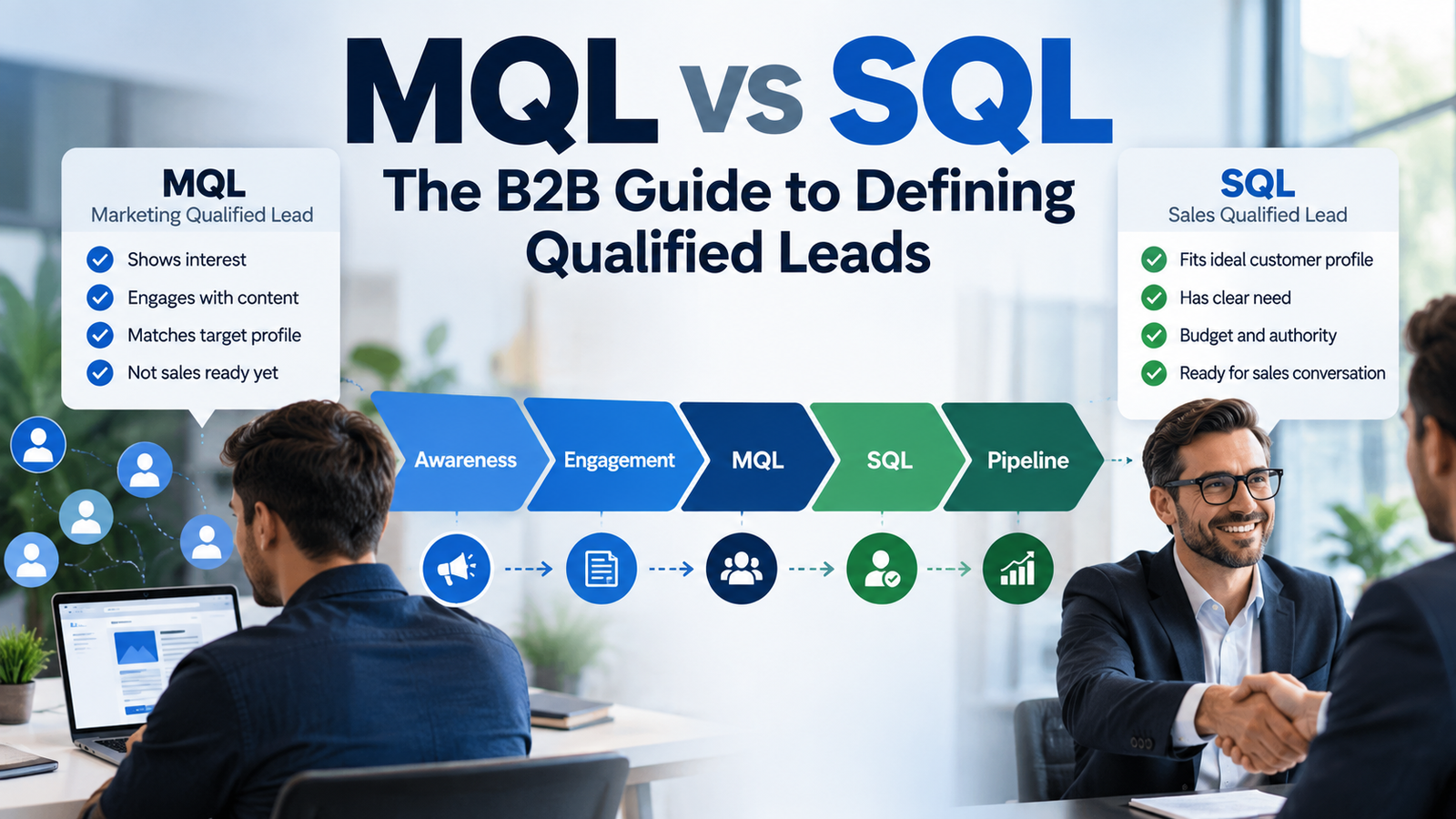
- MQL rate
- SQL rate
- Cost per SQL
- Opportunity rate
- Cost per opportunity
- Pipeline value
- Revenue contribution
The goal is not to eliminate top-of-funnel metrics. It is to stop treating them as the final answer.
Common B2B digital marketing mistakes
- Running channels independently with no shared strategy.
- Optimizing for lead volume while sales rejects the leads.
- Using one landing page for every campaign.
- Publishing broad content with no internal path to commercial pages.
- Ignoring offline sales outcomes in paid-media reporting.
- Assuming a platform is “bad” before checking the offer, audience, and conversion path.
Frequently asked questions
What is the best digital marketing channel for B2B?
There is no single best channel. Google Search is strong for existing demand, LinkedIn is strong for professional audience targeting, Meta can support demand creation and retargeting, and SEO builds longer-term discovery. The right mix depends on the buyer and market.
Does B2B digital marketing need content?
Usually, yes. Complex purchases require education, comparison, proof, and reassurance. Content gives paid, organic, sales, and nurture programs something useful to work with.
How long does B2B digital marketing take to work?
Paid search can create useful signals quickly when demand exists. SEO and content take longer to compound. Sales cycles can extend the time between first touch and revenue, which is why pipeline reporting matters.
Final takeaway
B2B digital marketing works best when channels are treated as parts of one buying journey. Capture demand where it exists, create demand where it does not, convert the right visitors, and connect the results to sales outcomes.
A 30-day B2B digital marketing plan
Week 1: Diagnose the revenue path. Define the ICP, buying triggers, priority services, current channel performance, conversion gaps, tracking gaps, and what sales considers a qualified opportunity.
Week 2: Fix the commercial foundation. Improve the pages closest to revenue, make the offer and qualification criteria clear, confirm tracking, and ensure CRM stages can distinguish enquiries from MQLs, SQLs, and opportunities.
Week 3: Launch the highest-confidence channel tests. Capture existing demand first where it clearly exists. Add LinkedIn, Meta, or content-led demand creation where the market needs education or the ICP is easier to target than the search query.
Week 4: Review quality, not just volume. Compare search terms, audiences, landing pages, MQL rate, SQL rate, sales feedback, and opportunity creation. Scale only the combinations producing better-fit pipeline.
B2B digital marketing scorecard
Before increasing spend, score the system against these questions:
- ICP: Can the team describe the companies and roles it wants, plus the poor-fit leads it wants to avoid?
- Intent: Does every campaign or content cluster match a clear buyer problem and stage?
- Message: Can a prospect understand the problem solved, expected outcome, and reason to trust the company within a few seconds?
- Conversion: Do high-intent visitors reach pages built for the specific offer rather than a generic homepage?
- Qualification: Are MQL and SQL definitions shared by marketing and sales?
- Measurement: Can reporting connect source, campaign, landing page, MQL, SQL, opportunity, and revenue?
- Feedback: Does sales regularly tell marketing which leads were accepted, rejected, or progressed?
If several answers are “no,” the highest-return move is usually to repair the system before adding another channel. More traffic does not fix unclear positioning, weak qualification, or missing sales feedback.
A practical B2B digital marketing operating rhythm
Review acquisition every week at the channel level, but review lead quality at the funnel level. Weekly checks can cover spend, search terms, audiences, creative, landing-page conversion, tracking failures, and lead-routing problems. Monthly reviews should go deeper into MQLs, SQLs, opportunities, and sales feedback.
Quarterly reviews should challenge the channel mix itself. Search demand may change. A new service may deserve its own landing page. A content cluster may begin creating qualified organic demand. A LinkedIn audience may become saturated. The plan should adapt to evidence instead of preserving the original media split out of habit.
If the objective is qualified pipeline, the question is not “Which channel should we use?” It is “What job should each channel do, and how will we know it is helping create the right opportunities?”