

 8 mins read
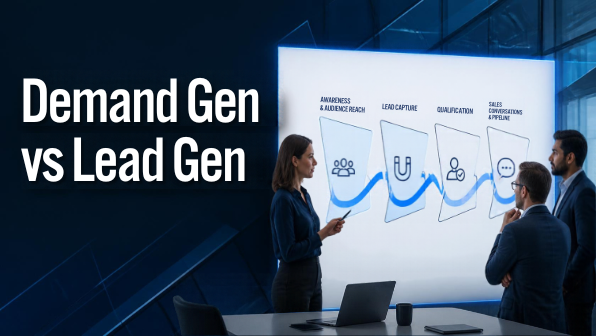
Demand generation creates interest and preference before a buyer is ready to talk. Lead generation converts some of that interest into identifiable contacts and sales opportunities. B2B companies usually need both. The mistake is treating them as interchangeable.
When the two are mixed together, teams often judge awareness campaigns by form fills or judge high-intent campaigns by reach. That creates bad decisions because the channel is measured against the wrong job.
Demand generation vs lead generation, in one sentence:
Demand generation makes the right market aware of the problem, solution, and brand; lead generation turns some of that interest into identifiable prospects that marketing and sales can qualify.
Demand generation vs lead generation: the simple difference
| Area | Demand generation | Lead generation |
|---|---|---|
| Primary job | Create awareness, understanding, and preference | Capture identifiable buying interest |
| Typical audience | Problem-aware or early-stage buyers | Higher-intent prospects |
| Typical content | Research, POV, guides, webinars, educational content | Service pages, demos, audits, consultations, pricing |
| Useful metrics | Target-account engagement, branded search, assisted pipeline | MQLs, SQLs, opportunities, cost per qualified lead |
Why B2B teams need both
If you focus only on lead generation, you may end up competing for the same small pool of buyers who are already in market. If you focus only on demand generation, you may build attention without a clear path to sales.
A healthy system creates awareness around the problem, builds trust through useful content and proof, captures active demand when it appears, and then qualifies the response. RSXigital’s B2B lead generation service is built around that full buyer-to-pipeline path.
What demand generation looks like in practice
Demand generation is not simply “brand marketing.” It should still be aimed at a defined market and a real commercial problem.
- Expert articles that explain a costly problem clearly
- Research or benchmark content buyers can use internally
- LinkedIn posts and ads aimed at relevant roles
- Educational webinars and workshops
- Comparison content that helps buyers understand trade-offs
- Retargeting that reinforces evidence instead of repeating the same ad
- SEO content around problem-aware and solution-aware searches
The goal is to make the company easier to recognize and easier to trust before the sales conversation starts.
What lead generation looks like in practice
Lead generation begins when the buyer takes an identifiable action that could reasonably lead to a commercial conversation.
- Requesting a demo
- Booking a strategy call
- Submitting a quote request
- Requesting an audit or assessment
- Responding to a high-intent paid search campaign
- Completing a qualified instant form
The quality of that lead depends on targeting, offer, landing page, qualification, and follow-up. More forms do not automatically mean more pipeline.
Where Google Ads fits
Google Search is often strongest on the lead-generation side because it can capture existing intent. A buyer searching for a specific agency, service, software category, or implementation partner is already expressing a problem in commercial language.
That is why our Google Ads for B2B work emphasizes search intent and qualified conversion feedback rather than treating every form fill equally.
Where LinkedIn fits
LinkedIn can support both sides. Thought-leadership content and video can create demand. Lead-gen forms, retargeting, account lists, and offer-led campaigns can capture it.
The important thing is not to force cold audiences into a sales request they are not ready for. A highly targeted audience can still ignore a weak offer.
Where SEO fits
SEO sits across the entire journey. A problem guide can create understanding. A comparison page can help evaluation. A service page can capture active demand. A case study can reduce perceived risk.
The recent RSXigital guide to B2B SEO strategy explains how those page types should connect rather than compete.
How to measure demand generation without hiding behind vanity metrics
Awareness metrics are useful, but they are not enough. Track whether the right people are engaging and whether that engagement later appears in buying behavior.
Useful signals include growth in branded search, direct traffic from target markets, repeat visits from target accounts, engagement with high-intent content, assisted conversions, and opportunities where the buyer consumed demand-generation assets before contacting sales.
Do not pretend every impression deserves revenue credit. The purpose is to understand influence, not manufacture attribution.
How to measure lead generation
Lead generation should be measured deeper than CPL:
- Lead-to-MQL rate
- MQL-to-SQL rate
- Cost per SQL
- Opportunity rate
- Cost per opportunity
- Pipeline created
- Closed-won revenue where attribution is reliable
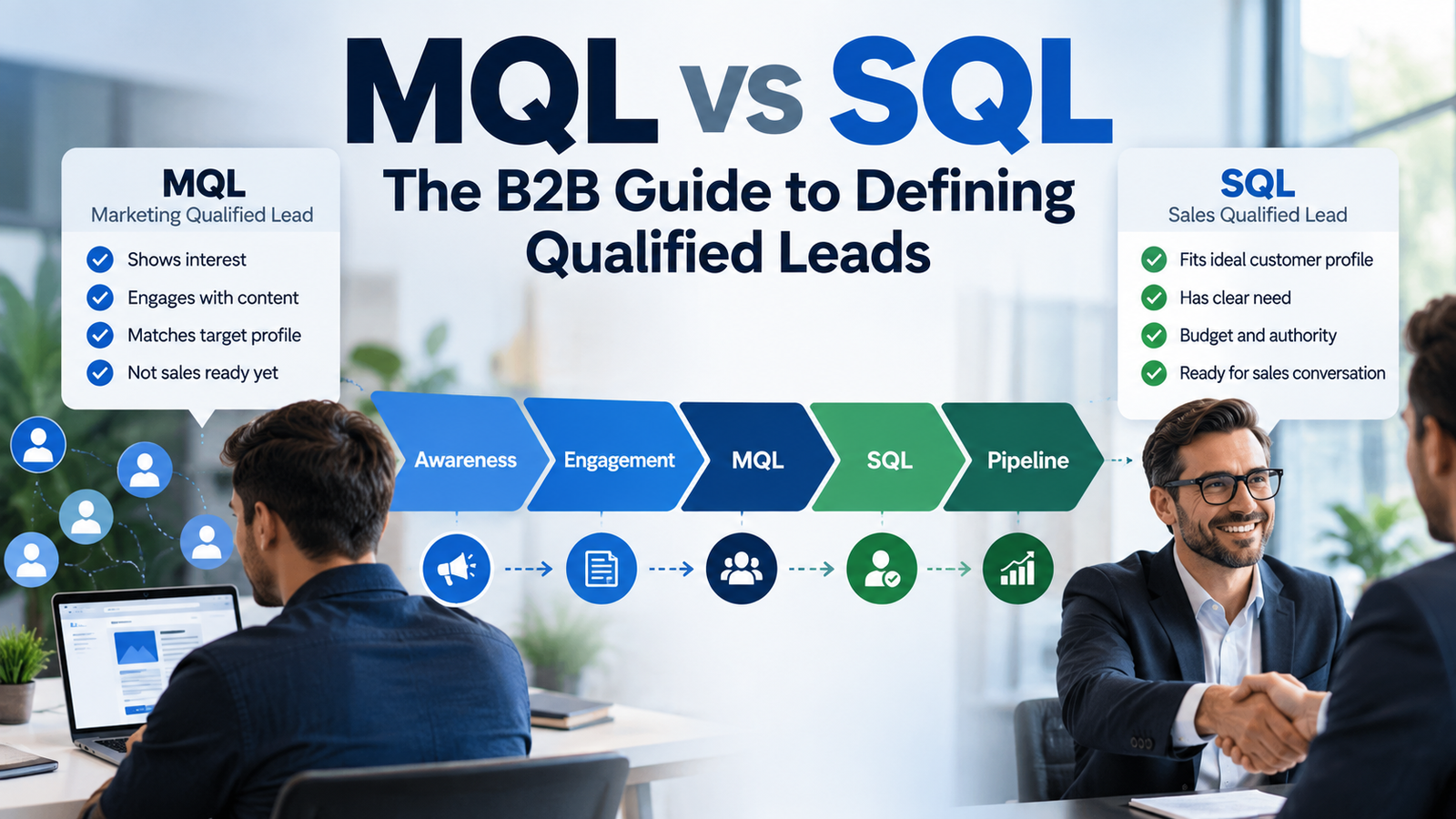
The MQL vs SQL guide is useful if marketing and sales still use different definitions of “qualified.”
A practical combined model
A strong B2B program treats demand generation and lead generation as connected stages rather than competing philosophies.
- Create relevance. Publish and distribute useful content around costly problems your ICP already recognizes or needs help understanding.
- Build evidence. Use case studies, expert points of view, implementation detail, comparisons, and proof to reduce uncertainty.
- Capture intent. Use Google Search, commercial SEO pages, retargeting, high-intent offers, and clear calls to action when buyers are ready to act.
- Qualify. Confirm company fit, role, need, timing, and commercial context instead of sending every form fill to sales.
- Feed outcomes back. Use CRM stages and sales feedback to improve targeting, creative, search terms, content, and qualification.
Which should you prioritize first?
| Your current situation | Priority | Why |
|---|---|---|
| Strong category search demand, weak share of voice | Lead generation first | Capture buyers already searching before investing heavily in creating more demand. |
| New or poorly understood category | Demand generation first | Buyers need education and problem awareness before direct-response offers can work efficiently. |
| Healthy lead volume, poor sales acceptance | Fix qualification | More demand or more leads will simply amplify the wrong audience or weak handoff. |
| Overdependence on expensive bottom-funnel channels | Add demand generation | Build future preference and reduce reliance on the same finite in-market audience. |
This is the same operating logic behind a broader B2B marketing strategy: give every channel a specific job, then judge it by the downstream outcome that job is supposed to create.
Common mistakes
- Calling every content impression “demand generation.”
- Gating every useful asset just to collect an email address.
- Judging awareness campaigns only by CPL.
- Judging high-intent search campaigns only by clicks.
- Failing to connect both programs to the same ICP.
- Running demand programs with no clear commercial destination.
Frequently asked questions about demand generation vs lead generation
Is demand generation better than lead generation?
No. They solve different problems. Demand generation creates awareness, understanding, and preference; lead generation captures identifiable intent. Strong B2B programs connect the two instead of choosing one as a permanent replacement for the other.
What is the main difference between demand generation and lead generation?
The main difference is the job. Demand generation increases the number of suitable buyers who understand and consider the category or brand. Lead generation captures contact information and buying signals from people who are ready to move closer to a sales conversation.
Can SEO be demand generation?
Yes. Problem-stage and educational content can create understanding before a buyer is ready to contact sales. Comparison, use-case, and commercial SEO pages can then capture later-stage demand. The strongest SEO programs support both jobs.
Should demand generation content be gated?
Not automatically. Gating makes sense when the asset is valuable enough to justify the exchange and the contact information creates a useful next step. Many educational assets work better when they are easy to access, share, and cite.
How do you measure demand generation?
Use a mix of target-account engagement, branded search, repeat visits, content consumption, assisted conversions, and pipeline influence. Avoid pretending every impression deserves direct revenue credit.
How do you measure lead generation?
Track lead volume, MQL rate, SQL rate, cost per SQL, opportunity rate, cost per opportunity, pipeline created, and closed-won revenue where attribution is reliable. CPL alone is not enough for a B2B program.
Can a company run lead generation without demand generation?
Yes, especially in an established category with strong existing search demand. The limitation is that the company may become dependent on the finite group of buyers already in market. Demand generation can expand future consideration and improve recognition over time.
Final takeaway
Demand generation and lead generation should share one commercial strategy. Create relevance before the buyer is ready, capture intent when it appears, and measure what becomes qualified pipeline.
How to decide what to fund first
If your category already has meaningful search demand, start by making sure you can capture it efficiently. Strengthen the commercial pages, paid search, organic service pages, comparison content, and conversion tracking that serve buyers already in market.
If search demand is weak or the category is unfamiliar, demand creation deserves more emphasis. Use expert content, LinkedIn, founder-led distribution, webinars, research, and targeted paid social to make the problem and solution easier to understand.
If lead volume is already healthy but sales acceptance is poor, neither more demand creation nor more lead generation is the first priority. Fix targeting, qualification, positioning, and the handoff.
How sales should participate
Demand generation is often treated as a marketing function, but sales has valuable information about objections, buying triggers, competitors, and what strong opportunities have in common. Feed those patterns back into content and campaigns.
Sales can also use demand assets directly. A useful comparison guide or industry framework can support follow-up with a prospect who is not ready for a proposal. That gives demand content a role beyond anonymous website traffic.
A practical measurement cadence
Review lead-generation performance weekly because spend and lead flow can change quickly. Review demand-generation trends over longer windows because awareness, brand search, target-account engagement, and assisted pipeline develop more slowly.
At the monthly or quarterly level, bring both together. Ask whether the market is becoming easier to reach, whether qualified demand is growing, and whether opportunities are appearing from the themes and audiences marketing is investing in.
A 30-day plan to connect demand and lead generation
Week 1: Define the commercial system. Agree on the ICP, buying triggers, MQL definition, SQL definition, key objections, and the services or products that deserve growth investment.
Week 2: Map demand. Separate topics and audiences into problem awareness, solution awareness, comparison, and vendor-evaluation stages. Identify where Google Ads, SEO, LinkedIn, Meta, email, and sales outreach each have a clear job.
Week 3: Fix the conversion path. Improve the service pages, landing pages, proof assets, forms, CRM source capture, and lead routing that turn interest into useful sales context. If the handoff is weak, scaling traffic is just a more expensive way to discover the same problem.
Week 4: Launch one connected test. Pair one demand asset with one capture path. For example, distribute an expert guide to a defined ICP, retarget engaged visitors with proof, and use a high-intent page or consultation offer to capture buyers who move closer to action. Track the journey through MQL, SQL, and opportunity rather than stopping at the form submission.
How to connect both programs to one content system
Demand content and lead-generation pages should not live in separate libraries. A problem-stage article can introduce a commercial framework, link to a comparison page, point to a case study, and eventually support a consultation or demo page. The internal links should reflect the buyer’s next question rather than an SEO checklist.
Use one editorial map with columns for audience, buying stage, commercial theme, primary CTA, supporting proof, and distribution channel. That helps marketing see where it has too much awareness content and too little decision-stage evidence.
What to do when demand is high but pipeline is weak
If branded search, website visits, webinar attendance, or social engagement are rising but qualified pipeline is not, inspect the transition from interest to conversion. The issue may be an unclear offer, weak proof, poor landing pages, slow follow-up, or qualification that does not match the audience being attracted.
Likewise, if lead volume is high but the market has little awareness of the brand, the company may be overdependent on expensive bottom-of-funnel channels. Building demand can reduce that vulnerability over time.
One final check is sales capacity. Creating more demand is pointless if response time is slow or the team cannot follow up properly. Match campaign volume to the operational ability to qualify and progress good opportunities.
The distinction helps teams stop asking every channel to do the same job and start building a buyer journey that actually makes sense.