


 8 mins read
SEO, AEO, and GEO describe overlapping ways to make a brand and its information easier to discover across traditional search engines and AI-assisted answer experiences. For B2B marketers, the practical mistake is treating them as three unrelated strategies.
Search behavior is changing, but the underlying job remains familiar: publish useful information, make it technically accessible, establish clear entities and expertise, answer buyer questions directly, and provide evidence worth referencing.
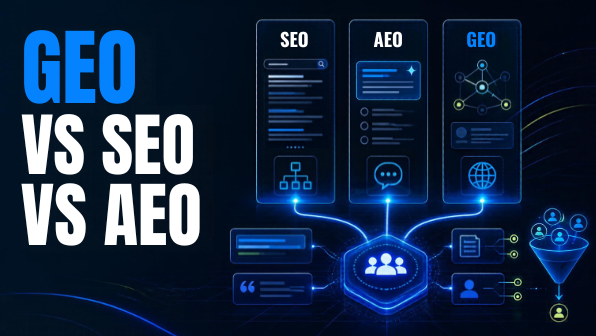
GEO vs SEO vs AEO, in one sentence:
SEO helps pages earn organic search visibility, AEO makes answers easier to extract, and GEO strengthens the brand’s chance of being understood and surfaced in generative AI experiences; in practice, all three should share one content and entity strategy.
GEO vs SEO vs AEO: simple definitions
| Term | Primary focus | Typical outcome |
|---|---|---|
| SEO | Organic visibility in search engines | Rankings, clicks, qualified organic visits |
| AEO | Clear answers to specific questions | Answer boxes, snippets, answer-engine retrieval |
| GEO | Visibility and citation in generative AI experiences | Brand inclusion in generated answers and research journeys |
The boundaries are fuzzy because the same page can support all three. A clear comparison article can rank in Google, answer a direct question, and provide structured information that an AI system can retrieve.
What traditional SEO still does
SEO helps search engines discover, crawl, understand, index, and rank pages for relevant queries.
The fundamentals still matter:
- Useful content matched to search intent
- Crawlable internal links
- Strong page titles and descriptions
- Technical accessibility
- Clear site architecture
- Relevant images and media
- Structured data where it accurately represents visible content
- Authority and evidence built over time
RSXigital’s B2B SEO strategy guide explains how those pieces connect to commercial pages and pipeline.
What AEO adds
Answer engine optimization emphasizes making information easy to extract as a direct response to a question.
That usually means clearer definitions, question-based headings, concise answers near the relevant heading, tables, step-by-step instructions, FAQs where they genuinely help, and strong context around entities and terminology.
AEO should improve readability for people too. If the answer is impossible to find without scrolling through twelve paragraphs of throat-clearing, the page probably has a human problem before it has an answer-engine problem.
What GEO adds
Generative engine optimization focuses on whether AI systems can understand, trust, retrieve, and reference information from a brand across generated responses.
For B2B companies, that means strengthening the signals around expertise, services, people, proof, comparisons, and business identity.
Useful GEO work may include:
- Clear company and service entity information
- Expert author pages
- Original case studies and evidence
- Detailed comparison content
- Consistent descriptions across the site
- Answer-first page structure
- Strong internal linking between related entities and services
- Accessible factual content rather than key information hidden inside images
Google’s current guidance: no secret AI markup
Google’s current documentation for AI features in Search says there are no additional technical requirements or special optimizations required to appear in AI Overviews or AI Mode beyond the normal requirements for Search eligibility.
Google specifically points back to familiar fundamentals such as crawlability, internal links, page experience, important content available in text, images and video that support the text, and structured data that matches visible content. See Google’s AI features and website guidance.
That is a useful antidote to vendors selling mysterious “AI schema” switches as if search engines forgot how websites work.
Why B2B brands should care
B2B buyers use search to learn, compare, validate, and shortlist vendors. AI-assisted research adds another interface to that journey.
If your company is absent from the information layer around its category, use cases, problems, and comparisons, buyers may encounter competitors first even before visiting a traditional search result.
That makes discoverability broader than rankings alone.
Build pages around entities and relationships
LLMs and search engines both benefit from clear relationships between concepts.
A B2B agency site should make it easy to understand:
- What services the company provides
- Which markets and industries it serves
- Who the experts are
- What case studies support the expertise
- How related services connect
- What terminology the company uses consistently
RSXigital’s AI search visibility service is built around this entity-and-evidence approach rather than isolated prompt tricks.
Use answer-first structure
For important questions, place the answer close to the heading. Then expand with context, examples, trade-offs, and evidence.
Useful structures include:
- Definition followed by explanation
- Comparison tables
- Pros and cons
- Step-by-step processes
- Decision frameworks
- Short FAQs based on real buyer questions
This helps readers scan the page and gives retrieval systems clearer passages to work with.
Original evidence matters more as generic content becomes abundant
AI can make generic explanatory content cheaper to produce. That increases the value of information that comes from real expertise.
Examples include original frameworks, field observations, first-party research, founder perspectives, implementation detail, anonymized campaign learnings, and case studies with defensible claims.
RSXigital’s case-study library provides that kind of proof layer for commercial content.
Keep commercial intent in the architecture
AI visibility is not useful if the site has no route from educational discovery to a commercial next step.
Connect guides to relevant service pages, comparisons to proof, case studies to the services they demonstrate, and expert pages to the work those experts lead.
A 10,000-monthly-organic-traffic goal becomes much more valuable when the traffic is distributed across informational and commercial journeys rather than concentrated in broad top-of-funnel content.
How to measure SEO, AEO, and GEO together
Traditional SEO has mature metrics: impressions, clicks, rankings, landing-page traffic, and conversions. AI visibility measurement is still less standardized.
Use a layered model:
- Search Console impressions and clicks
- Organic landing-page engagement
- Brand search growth
- Referral traffic from AI platforms where identifiable
- Prompt/answer monitoring for priority commercial topics
- Mentions and citations across AI research experiences
- Qualified leads and opportunities influenced by organic discovery
Do not invent a single “GEO score” and treat it as revenue. Use multiple signals and watch how they change over time.
What not to do
- Create hundreds of near-duplicate pages for imagined AI prompts.
- Add unsupported statistics because they look quotable.
- Hide important factual information only inside graphics.
- Create fake expert profiles or author pages.
- Stuff FAQs with every possible query variant.
- Assume schema alone creates AI citations.
- Separate GEO from the site’s broader SEO and content strategy.
A practical combined framework
Step 1: Establish commercial entities. Make services, markets, people, and proof clear.
Step 2: Cover buyer questions. Build useful pages for problems, comparisons, use cases, and decisions.
Step 3: Structure answers clearly. Use descriptive headings, concise answers, tables, and lists where helpful.
Step 4: Add evidence. Support claims with case studies, experts, credible sources, and specific process detail.
Step 5: Connect the site. Use internal links to show relationships between topics and commercial pages.
Step 6: Measure both visibility and pipeline. Track search performance, AI visibility signals, and downstream outcomes.
Frequently asked questions
Is GEO replacing SEO?
No. AI-assisted search expands the discovery surface, but normal search visibility, crawlability, content quality, and site authority remain foundational.
Is AEO the same as GEO?
They overlap. AEO focuses on providing clear answers. GEO focuses more broadly on visibility in generative AI responses. Strong answer structure can support both.
Do I need special schema for AI search?
Google says no special markup is required for its AI search features. Use structured data when it accurately represents visible page content and serves a normal search purpose.
Final takeaway
SEO, AEO, and GEO are better treated as layers of one discovery strategy. Build useful pages, make answers easy to find, establish clear entities, add real evidence, and connect visibility to qualified pipeline.
A 90-day SEO + AEO + GEO roadmap
Days 1–30: Fix entity and commercial clarity. Audit core service pages, company information, expert profiles, case studies, internal links, structured data, and indexability. Make sure the site uses consistent names for services, markets, people, and expertise.
Days 31–60: Build answer-ready topic coverage. Publish or improve high-value pages around buyer problems, comparisons, implementation questions, alternatives, and decision criteria. Start important sections with direct answers, then expand with nuance, proof, examples, and links.
Days 61–90: Add evidence and measure visibility. Strengthen first-party frameworks, case studies, expert commentary, source citations, and commercial proof. Monitor Search Console, branded search, identifiable AI referrals, priority answer visibility, and downstream lead quality rather than chasing a single invented GEO score.
Example: optimizing one B2B page for SEO, AEO, and GEO
Suppose a B2B software company has a page about marketing attribution software. Instead of creating three separate pages for SEO, AEO, and GEO, improve the same authoritative page in layers:
- SEO layer: target the commercial topic clearly in the title, URL, headings, copy, internal links, and supporting content.
- AEO layer: add a concise definition, direct answers to common buyer questions, a comparison table, implementation steps, and clear FAQs.
- GEO layer: strengthen company and product entity information, name credible experts, add original frameworks or research, cite changing platform facts to primary sources, and connect the page to relevant case studies and service pages.
- Commercial layer: give the reader a logical next step such as a product evaluation, service consultation, comparison page, or case study.
- Measurement layer: track organic impressions, qualified traffic, answer visibility, identifiable AI referrals, assisted conversions, and downstream pipeline.
One strong page can therefore serve all three disciplines. Creating separate near-duplicate pages for each acronym usually adds complexity without adding value.
SEO, AEO, and GEO content checklist
- Intent: Does the page answer a real buyer problem or decision?
- Direct answer: Can a reader find the core answer quickly?
- Entity clarity: Are the company, service, expert, market, and related concepts named consistently?
- Evidence: Are claims supported by first-party proof, expert analysis, or credible primary sources?
- Structure: Do headings, tables, lists, and comparison sections make the page easy to scan and retrieve?
- Internal links: Does the page connect naturally to related expertise, services, case studies, and conversion paths?
- Commercial path: Is there a sensible next step for a buyer who wants deeper evaluation?
- Freshness: Are time-sensitive platform claims reviewed before publication and again when products change?
How to prioritize GEO work on an existing B2B site
Start with pages closest to commercial value. Make sure the core service pages clearly state what is offered, who it is for, where it is available, how the process works, and what evidence supports the offer. Then improve the supporting content that explains the problems, comparisons, use cases, and implementation questions around those services.
Next, strengthen entity pages. Founder, team, company, case-study, and service pages should use consistent names and relationships. If the site describes the same service five different ways, both people and machines have more work to do.
Build citation-worthy passages
A page is easier to reference when it contains concise factual passages, definitions, frameworks, and comparisons that stand on their own. This does not mean writing robotic fragments. It means making the answer visible before expanding into nuance.
Use primary sources for changing platform facts. Label your own frameworks as your own. Avoid invented percentages and generic claims that cannot be verified. Credibility is part of retrieval quality.
Review visibility by commercial topic, not vanity prompts
Track whether the brand appears around topics that matter to revenue: service categories, buyer problems, comparisons, implementation questions, and market-specific needs. A mention in a broad irrelevant prompt is less useful than being consistently surfaced for a high-intent category.
Combine that monitoring with Search Console, analytics, branded search, referral data, and CRM outcomes. AI visibility is one part of discovery, not a replacement for the rest of the funnel.
For the commercial implementation, see RSXigital’s AI Search Visibility and B2B SEO services.

