

 8 mins read
LinkedIn Ads and Google Ads solve different B2B acquisition problems. Google Ads is strongest when buyers are actively searching for a solution. LinkedIn Ads is strongest when you can identify the right companies and professional roles before they search.
That is why the useful question is not “Which platform is better?” It is “Where does our buyer show intent, and how precisely can we reach them?”
LinkedIn Ads vs Google Ads: the short answer
| Area | Google Ads | LinkedIn Ads |
|---|---|---|
| Primary strength | Captures active search demand | Targets professional audiences |
| Best signal | Search query and intent | Company, role, industry, seniority |
| Typical challenge | Irrelevant or ambiguous queries | Cold audiences and expensive attention |
| Best use | Demand capture | Demand creation and account targeting |
When Google Ads is the better fit
Google Ads is usually stronger when buyers already know what they need and are searching with commercial intent. A query such as “enterprise payroll software,” “B2B SEO agency,” or “industrial UPS supplier” gives the advertiser a direct signal about the problem the person is trying to solve.
That does not mean every search is valuable. B2B campaigns need careful query review because broad terms can attract students, consumers, job seekers, vendors, and businesses outside the target market.
RSXigital’s Google Ads for B2B approach focuses on intent, qualification, and downstream lead quality rather than click volume alone.
When LinkedIn Ads is the better fit
LinkedIn can be stronger when the target market is identifiable by professional data but search demand is limited, inconsistent, or too small to support growth on its own.
LinkedIn currently supports targeting using company, job experience, education, demographics, interests, Matched Audiences, and other professional attributes. That gives B2B marketers a level of account and role precision that search platforms are not designed to replicate. See LinkedIn’s current targeting documentation.
See RSXigital’s LinkedIn Ads for B2B service for the broader commercial approach.
Intent vs targeting: the core strategic difference
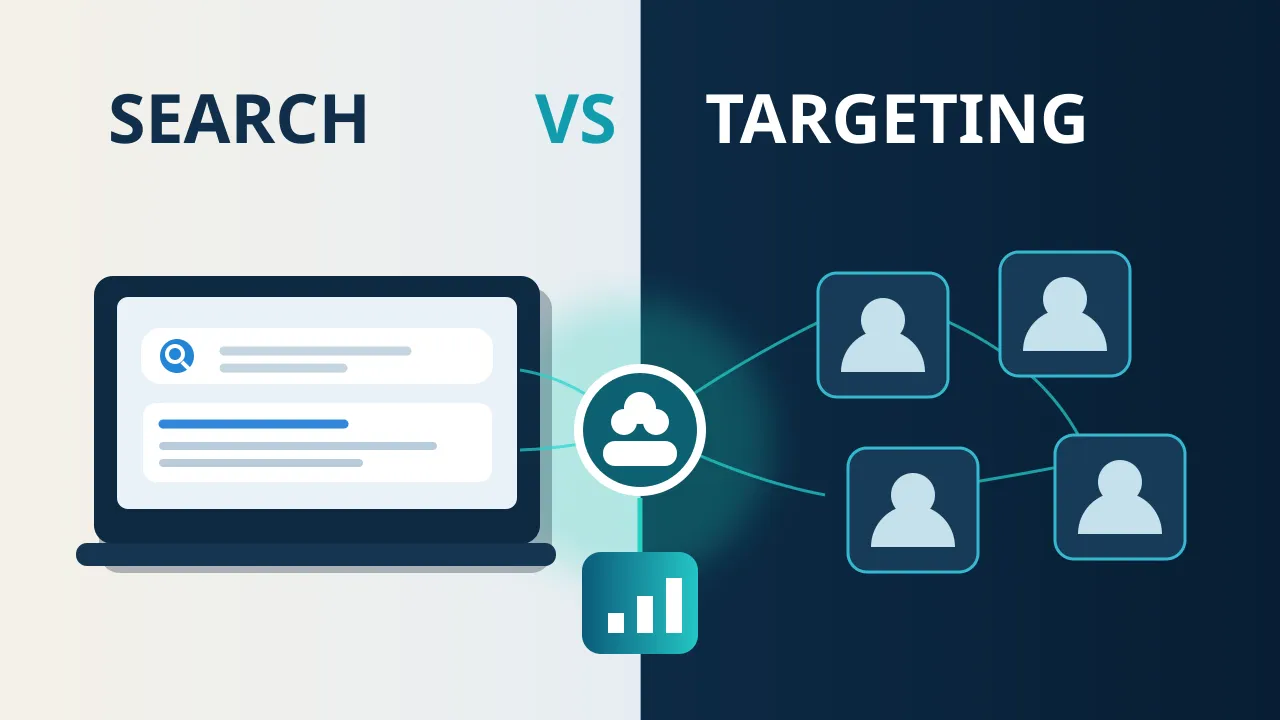
Google starts with intent and asks, “Who searched for this?” LinkedIn starts with identity and asks, “Which professionals should see this?”
That distinction should shape the campaign. Google landing pages can often be more direct because the visitor initiated the search. LinkedIn visitors may need more context, proof, education, or a lower-friction offer before they are ready for a sales conversation.
How offers should differ
A high-intent Google search can support offers such as consultations, demos, quote requests, audits, or service enquiries.
Cold LinkedIn audiences may respond better to a benchmark, assessment, webinar, case study, checklist, industry guide, or point-of-view asset before a direct sales CTA.
This is not a rule. A strong offer to a narrowly defined LinkedIn audience can generate direct conversations. The point is to match the ask to the buyer’s level of awareness.
How landing pages should differ
Google traffic often arrives with a specific query. The page should mirror that problem and make the commercial next step obvious. LinkedIn traffic often needs a stronger reason to care because the user did not start with a search.
For both channels, a strong B2B page should explain who the offer is for, what problem it solves, what the process looks like, why the company is credible, and what happens after the form is submitted.
RSXigital’s B2B landing-page optimization approach treats conversion quality as part of media performance, not a separate design exercise.
Lead quality depends on qualification
A short form can increase submissions while reducing context. A long form can create unnecessary friction. The right balance depends on deal value and how much information sales needs before follow-up.
Useful qualification fields may include company, work email, company size, service required, budget range, timeline, or main challenge. The form should collect what helps route and qualify the lead, not everything sales could possibly ask later.
Cost per lead is not enough
Google may produce cheaper or more expensive leads than LinkedIn depending on the market. LinkedIn may produce fewer leads but better-fit accounts. The only sensible comparison is downstream.
- Lead-to-MQL rate
- MQL-to-SQL rate
- Cost per SQL
- Opportunity rate
- Pipeline per channel
- Revenue contribution where attribution is reliable
A platform with a higher CPL can still be the better investment if sales accepts more of the leads.
Use CRM feedback to improve both platforms
Marketing should know why sales accepts or rejects leads. Feed that information back into keywords, audiences, forms, creative, and landing pages.
Google Ads combined enhanced conversions for web and leads under a unified setting in 2026. Google also announced a June 15, 2026 migration for many offline conversion uploads to the Data Manager API, with restrictions on legacy Google Ads API uploads. Teams importing CRM-qualified outcomes should check their existing method and eligibility rather than assume an older API integration still works. See Google’s enhanced conversions settings update and enhanced conversions for leads guidance.
Should B2B companies run both?
Often, yes, when the market supports it.
Google can capture active demand while LinkedIn builds familiarity with target accounts. A buyer may first see a LinkedIn message, later search the company or service on Google, read a case study, and then book a call.
The channels should share messaging and measurement instead of competing for isolated attribution credit.
A practical channel decision framework
Choose Google first when: meaningful search demand exists, buyers use clear commercial queries, and you have pages matched to those searches.
Choose LinkedIn first when: the market is narrow, roles and companies are identifiable, search volume is limited, and the offer needs proactive distribution.
Use both when: you need to create awareness among named buyers while also capturing demand as it appears.
How to choose between LinkedIn Ads and Google Ads: a decision scorecard
Before choosing a channel, score your market on the evidence you already have. This is a planning tool, not a claim that one platform always wins.
| What you know about your buyers | Stronger starting point | What to verify |
|---|---|---|
| Buyers search for a specific service or vendor | Google Search | Commercial queries, CPC estimates, page fit |
| A new category needs explanation before buyers search | Role-level audience size, proof, educational offer | |
| A defined list of target companies drives sales | LinkedIn account targeting | Matched accounts, reach, buying-committee roles |
| Both search demand and account targeting are viable | Run distinct tests on both | Cost per accepted SQL and opportunity quality |
| No reliable CRM source or qualification data exists | Fix measurement first | Source capture, lead ownership, sales acceptance |
LinkedIn’s official targeting guide documents professional attributes such as company, industry, seniority, and job title. Its Matched Audiences guidance explains contact, website, and company targeting. These options can help you reach a buying committee, but a smaller audience is not automatically a better audience. Check delivery potential before layering every filter.
Step-by-step: a 30-day B2B channel test
- Step 1, days 1–5: define the sales outcome. Agree on your ideal customer profile, disqualification reasons, lead ownership, and the difference between a form submission, an MQL, and an SQL. Check that every inquiry has a source and campaign field in the CRM.
- Step 2, days 6–10: map buyer intent. Review commercial search terms and estimated demand for Google. For LinkedIn, check the reachable audience by company type, seniority, role, and geography. Write down the buying problem and offer for each channel.
- Step 3, days 11–15: build separate paths. Give Google Search a page that directly answers the searched need. Give cold LinkedIn audiences a reason to engage, such as a useful comparison, assessment, or credible proof. Use consistent definitions for qualification, but do not force identical creative or forms.
- Step 4, days 16–25: inspect quality, not only cost. Review Google’s search terms and negatives. Google’s search terms report guidance explains how to find irrelevant queries; not every query is necessarily shown in the report. Review LinkedIn’s audience and lead-form performance and ask sales which leads are worth a conversation.
- Step 5, days 26–30: decide what to keep testing. Compare accepted leads and early opportunities, document the sample size, and identify which objections or disqualification reasons appear by source. A 30-day test is a diagnostic, not proof of revenue impact for a six-month sales cycle.
Example: comparing channel economics without inventing benchmarks
Imagine a B2B services company spends $3,000 on each channel in a controlled test. These numbers are illustrative arithmetic, not industry averages or an RSXigital client case:
| Illustrative outcome | ||
|---|---|---|
| Spend | $3,000 | $3,000 |
| Raw leads | 30 | 12 |
| Sales-accepted SQLs | 3 | 4 |
| Cost per raw lead | $100 | $250 |
| Cost per SQL | $1,000 | $750 |
The cheaper raw lead source is not the cheaper qualified lead source in this example. But four SQLs versus three is too small a sample to declare a permanent winner. Compare opportunity size, buyer fit, sales effort, and later-stage results before shifting most of the budget.
How to handle conversion tracking and privacy
LinkedIn offers website conversion tracking, manual uploads, and Conversions API connections for offline outcomes, as described in its official conversion tracking documentation. Its Lead Gen Forms can collect prefilled professional details and send them to a CRM. Prefilled data reduces typing, but it does not establish budget, need, or purchasing authority.
For both platforms, obtain appropriate consent, use supported integrations, deduplicate conversion events, and keep CRM stage definitions consistent. Imported conversions can improve measurement; they do not eliminate attribution uncertainty. If a deal has several decision-makers and multiple touchpoints, avoid presenting platform-reported pipeline as uniquely caused revenue.
Common mistakes
- Comparing platforms only by CPL.
- Using the same creative and offer on both channels.
- Sending LinkedIn traffic to a page written for high-intent searchers.
- Using broad Google keywords when buyer intent is unclear.
- Failing to connect sales feedback to campaign decisions.
- Declaring a platform “doesn’t work” before fixing the funnel.
Frequently asked questions
Is LinkedIn more expensive than Google Ads for B2B?
It can be, but platform-level cost is not enough to judge performance. Compare qualified leads, opportunities, and pipeline rather than click or CPL alone.
Which is better for B2B SaaS?
Google is strong when buyers actively search the software category. LinkedIn is strong when the company needs to reach specific roles or accounts before they search. Many SaaS teams use both.
Can LinkedIn Ads generate direct leads?
Yes, especially with strong offers and clear audience fit. Cold audiences may still need more education than high-intent searchers.
Why the two channels can work together
Google Ads and LinkedIn Ads can complement one another when each has a distinct job. Google captures active demand; LinkedIn reaches a defined professional audience. Both should use shared qualification rules and pipeline reporting rather than competing to claim the same sale.
How to split budget when using both platforms
Do not default to a 50/50 split. Start with the available intent. If there is strong commercial search volume, Google may deserve the larger initial share because it can capture demand already in market. If the total addressable audience is narrow and search volume is limited, LinkedIn may need more budget to reach target accounts proactively.
Reserve enough spend on each platform to learn. A tiny LinkedIn test against a well-funded Google campaign does not provide a fair comparison. Likewise, a broad Google campaign that mixes unrelated intent will make search look worse than it is.
Use a shared qualification model
Both channels should feed the same lifecycle definitions. If marketing calls a LinkedIn lead qualified because the company fits the ICP but calls a Google lead qualified merely because someone submitted a form, channel comparisons become meaningless.
Use the same MQL and SQL logic, then segment by source to see where quality differs. Sales rejection reasons are particularly useful: wrong company size, wrong geography, no budget, consumer inquiry, vendor, student, or no active need.
Run the comparison at the opportunity level
After enough data accumulates, compare the channels by cost per accepted opportunity and pipeline quality. Review deal size, sales velocity, and win rate if sample sizes are meaningful. This is slower than reading a CPL dashboard, but B2B economics are inconveniently attached to actual sales.
How to sequence the channels over a buying cycle
For long B2B sales cycles, the platforms can support different moments rather than compete for the same click. LinkedIn can introduce a point of view to a defined audience. Retargeting can reinforce a case study or webinar. Google Search can capture later demand when someone begins researching vendors or specific solutions.
The sequence does not need to be perfectly trackable to be strategically useful. What matters is whether the messaging is consistent and whether the buyer finds stronger evidence at each step.
Use search terms and LinkedIn demographics as research inputs
Google search-term data can reveal how buyers describe problems. LinkedIn professional demographic reporting can show which job functions, industries, companies, seniority levels, and company sizes engage with campaigns. Use those insights to improve messaging across both channels rather than keeping platform learning trapped inside each dashboard.
For broader context, see RSXigital’s guide to B2B lead generation strategies and the Google Ads lead-quality guide.